
Note: for a closer look, click any of the images, and the enlarged versions will open in a new tab.
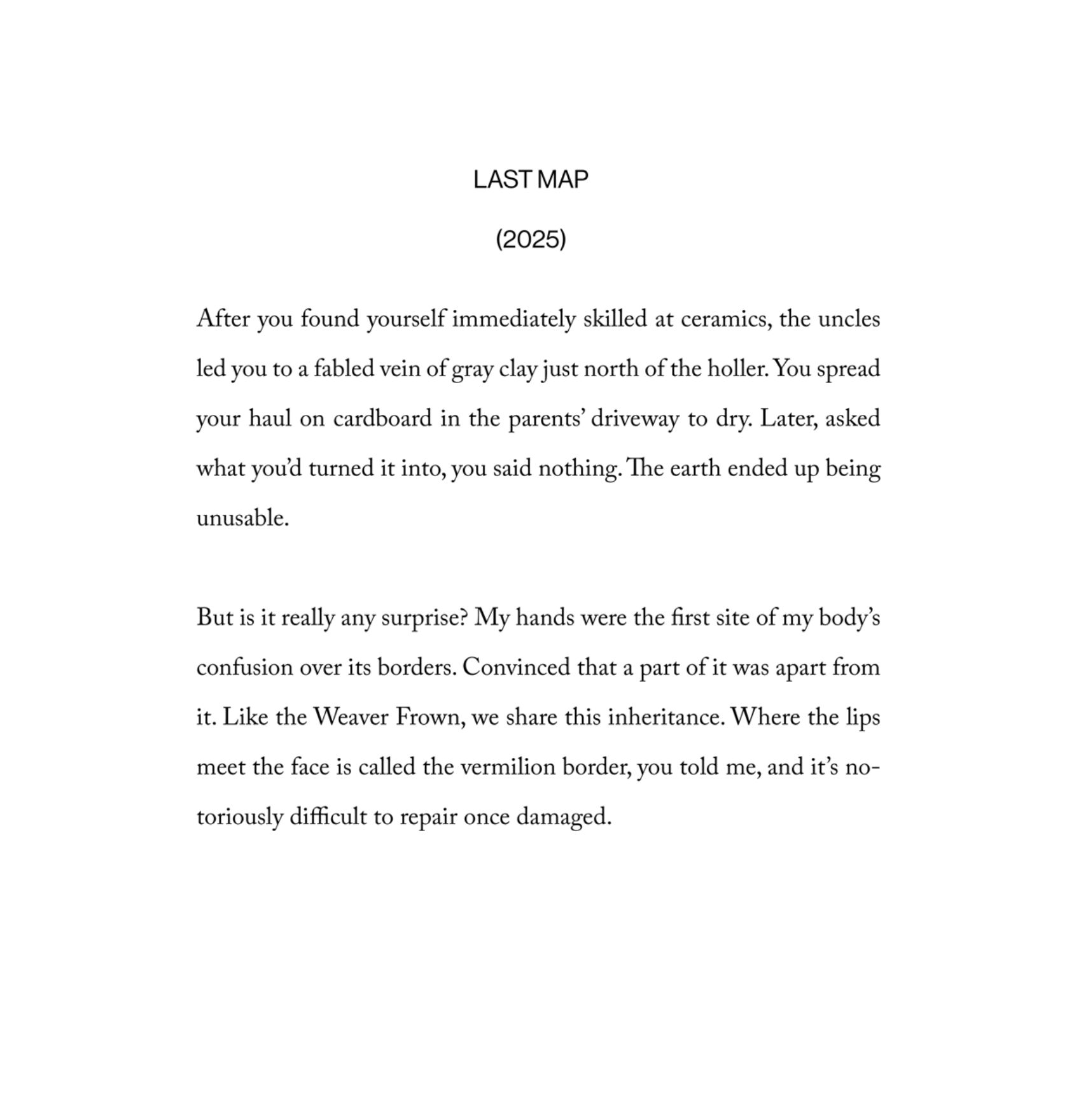
For Amy Sacksteder: Tell us more about the creation of this series—what drew you to these places? What brought you to the topographical style?
AS: The drawings in the series Last Map emerged from 2009 – 2010 and were made exclusively at artist residencies: in Budapest x 2, Reykjavík x 2, and Philadelphia. I was thinking a lot at the time about the liminal space at the juncture of life and death, looking to noteworthy figures’ last words for some kind of insight. I was particularly interested in Amelia Earheart’s final flight and last radio transmission, and the islands she was navigating toward and may have been a castaway upon: Howland and Gardner (now called Nikumaroro). While plumbing this content, I attended my first residency in Iceland at SÍM, in June 2010, just following the Eyjafjallajökull volcanic eruption that grounded flights all over Europe and in the wake of the BP oil spill in the Gulf of Mexico. Wanting to make sense of such occurrences in the context of deep time, these and other natural and manmade disasters crept into the content of the drawings. The visual language of maps and a line-based, illustrative approach ebbed into the work from much of my then-experience traveling to residencies and throughout Iceland, as well as my source imagery of variously sourced sea maps, and my own snapshot images: continental rifts, statues, and elements from the natural world.
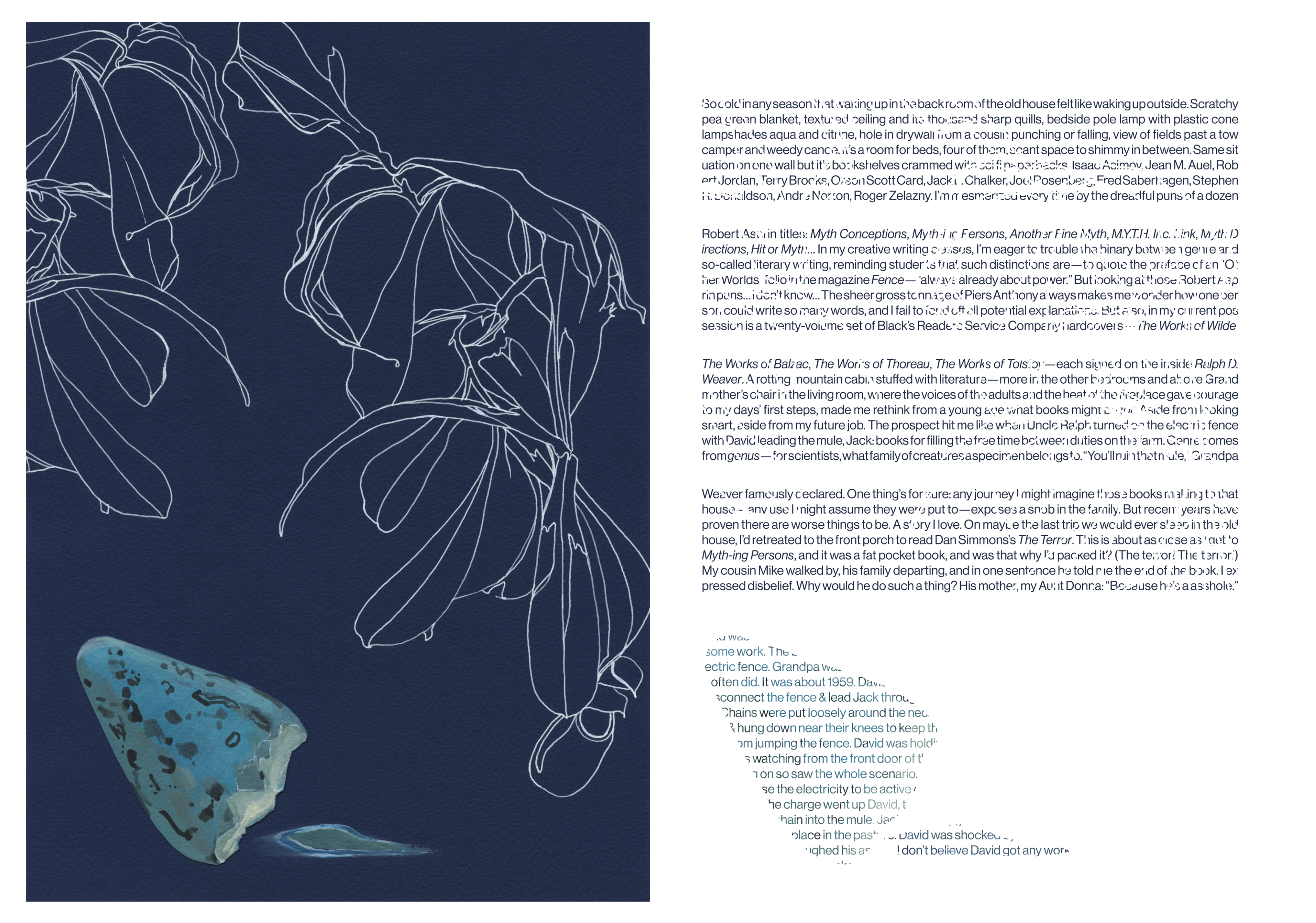
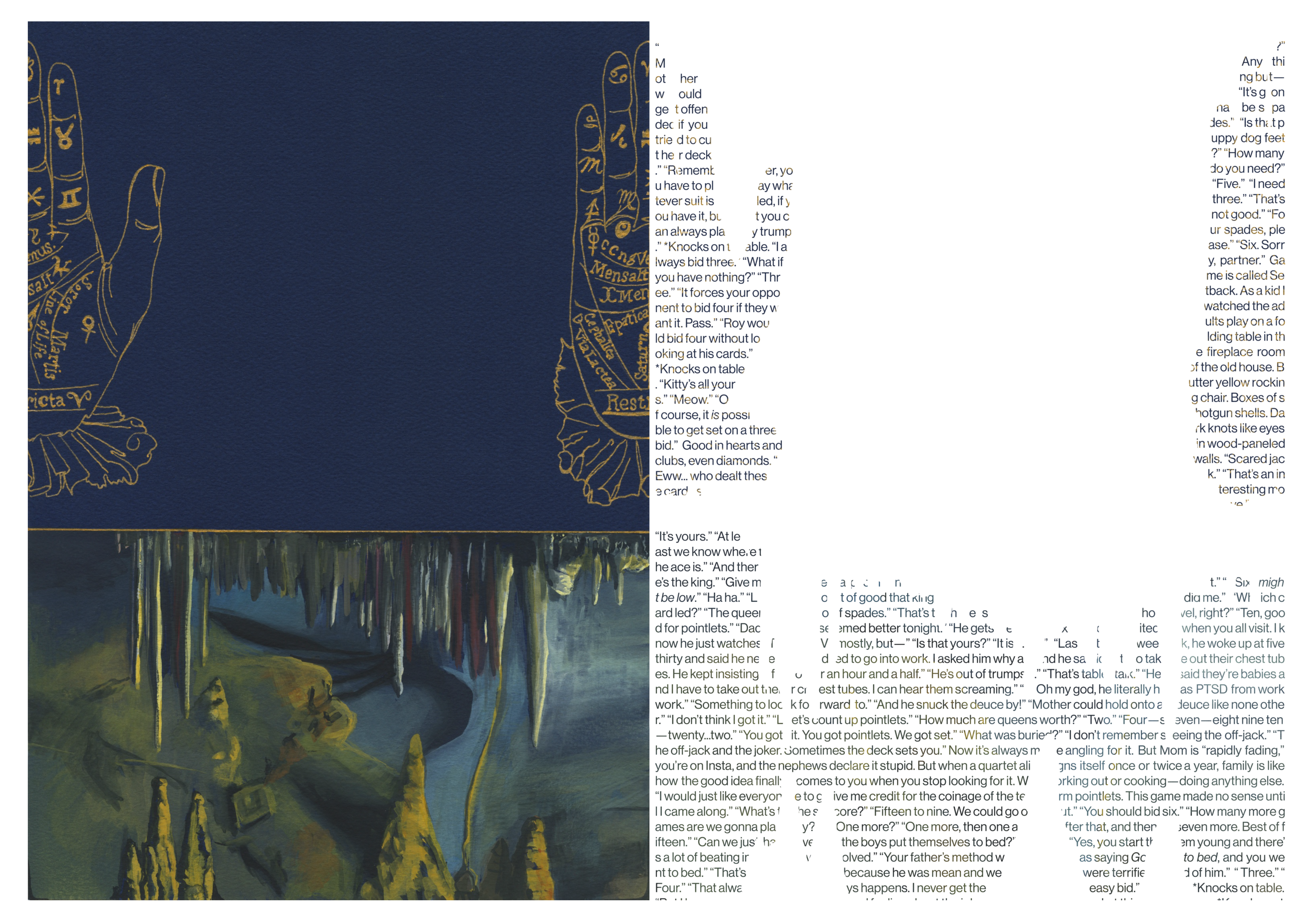
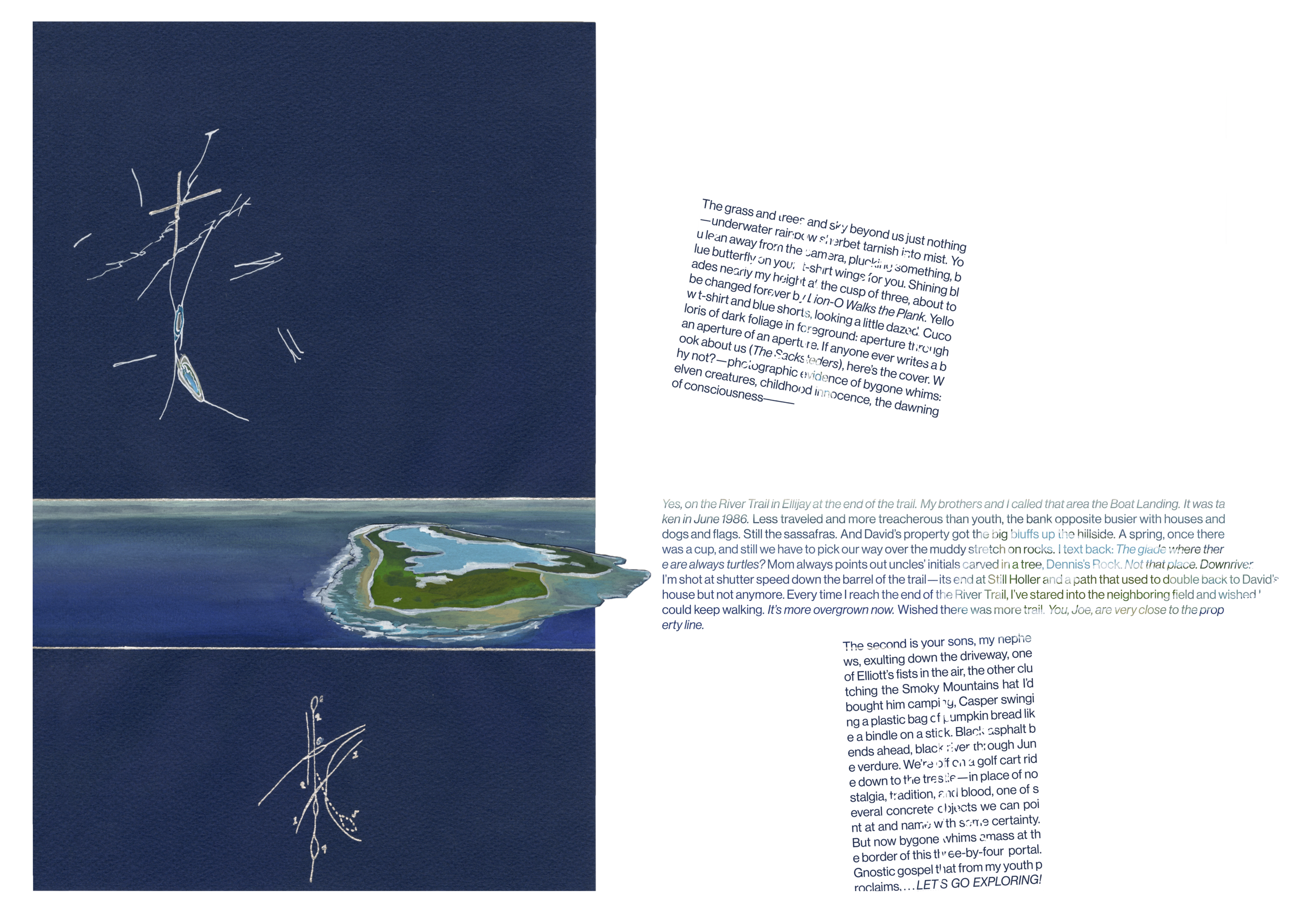
For Joe Sacksteder: We’d love to hear more about the process of constructing these “textual sculptures”? What drew you to connecting an essay to the architecture of these artworks?
Joe Sacksteder: I came up with the idea for these pieces in part because I was living in the mountains for the first time in my life, during my PhD program at the University of Utah. And, whenever I gained any elevation above Salt Lake City, whether I was jogging the Bonneville Shoreline Trail or driving up to Park City for hockey, I was enchanted at seeing the entire city poured out in the Wasatch Valley. Similarly, Salt Lake is constructed on a grid, so it’s the only place I’ve ever lived where I always knew what direction was north, south, east, west. When I go back to Salt Lake, everything feels like it’s even more spatially burned into my memory because of the grid and because of the familiar mountain line above the city. The way that the strictness of that grid dissolves into the sheer flux, disorder, and comparable lifelessness of the Great Salt Lake and the surrounding desert—it seemed to echo what I was learning in my PhD program about learning, about knowledge, about identity, about taxonomy, and about our human attempts to bend the world to our systems. I hope some of that comes through in the pieces.
In a class called Narrative Forms with Lance Olsen, he would have us complete “amphibious responses” to books we were reading, and I made my first attempt at a Last Map after reading Steve Tomasula’s highly visual novel, Vas: An Opera in Flatland. During workshop, Lance said “This is really interesting, but the writing’s no good.” He was right—I’d spent so much time on the tech aspect that I hadn’t been paying attention to the language. It wasn’t until about four years later, during the pandemic, that I had the time to do things right. The hardest trick on Adobe InDesign was figuring out how to make the colors of the drawings show through the text. After that, however, the many hours of zooming way in and cutting around positive and negative spaces were really meditative. I was able to listen to music with lyrics while “writing” for the first time in my life.
Half the pieces are about Utah, or the Rocky Mountains in general, and half the pieces are about the tin-roof cabin and subsistence farm in northern Georgia where my mom grew up—a property that Amy and I continue to visit to this day. As she created many of her Last Map drawings—the title is hers, by the way—while at a residency in Iceland, I see my contributions as triangulating three mountainous regions—one that’s dear to me, one that’s dear to my sister (that I’ve never been to), and one that we share in common. I’m interested in exploring the idea of shared consciousness.
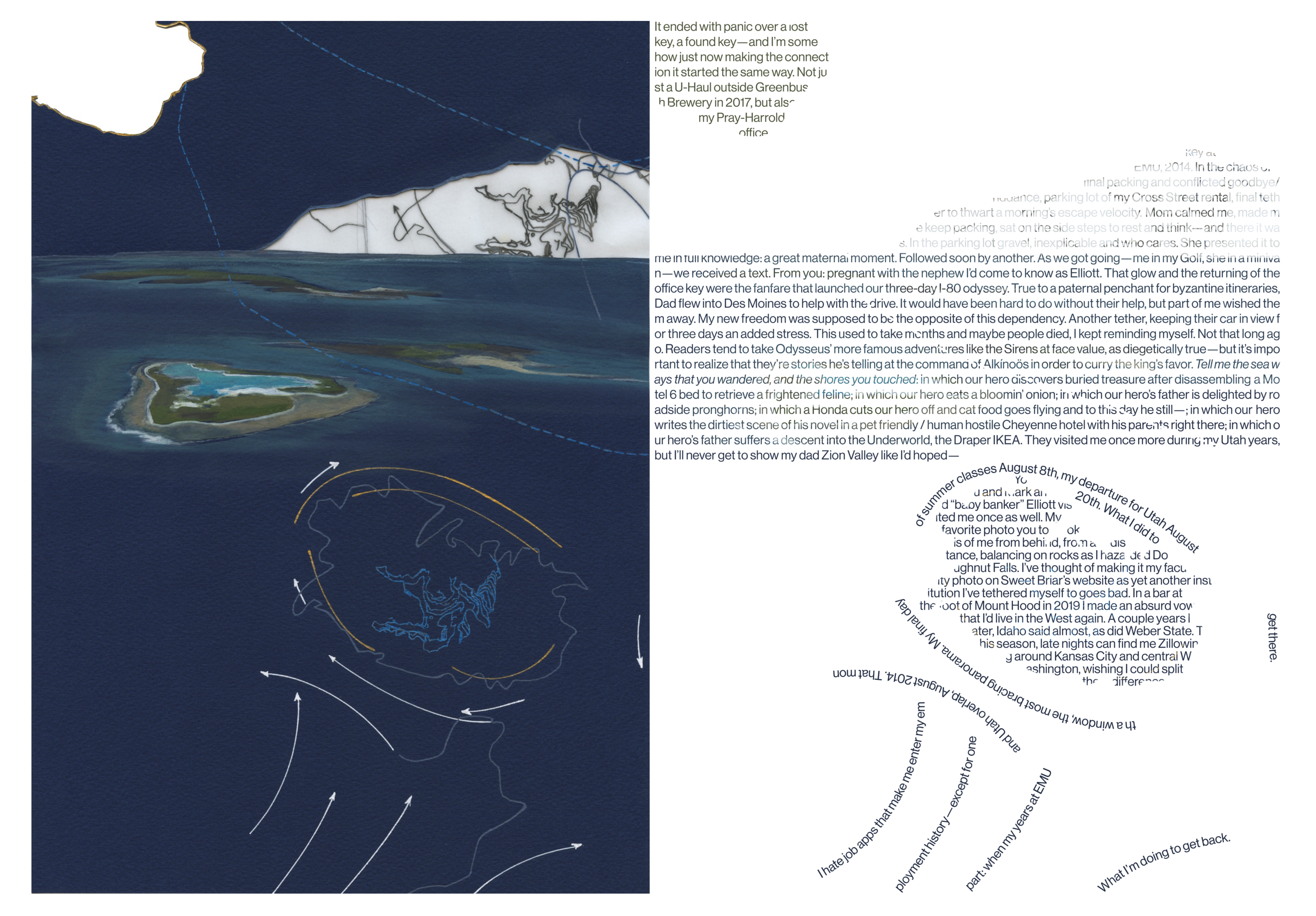
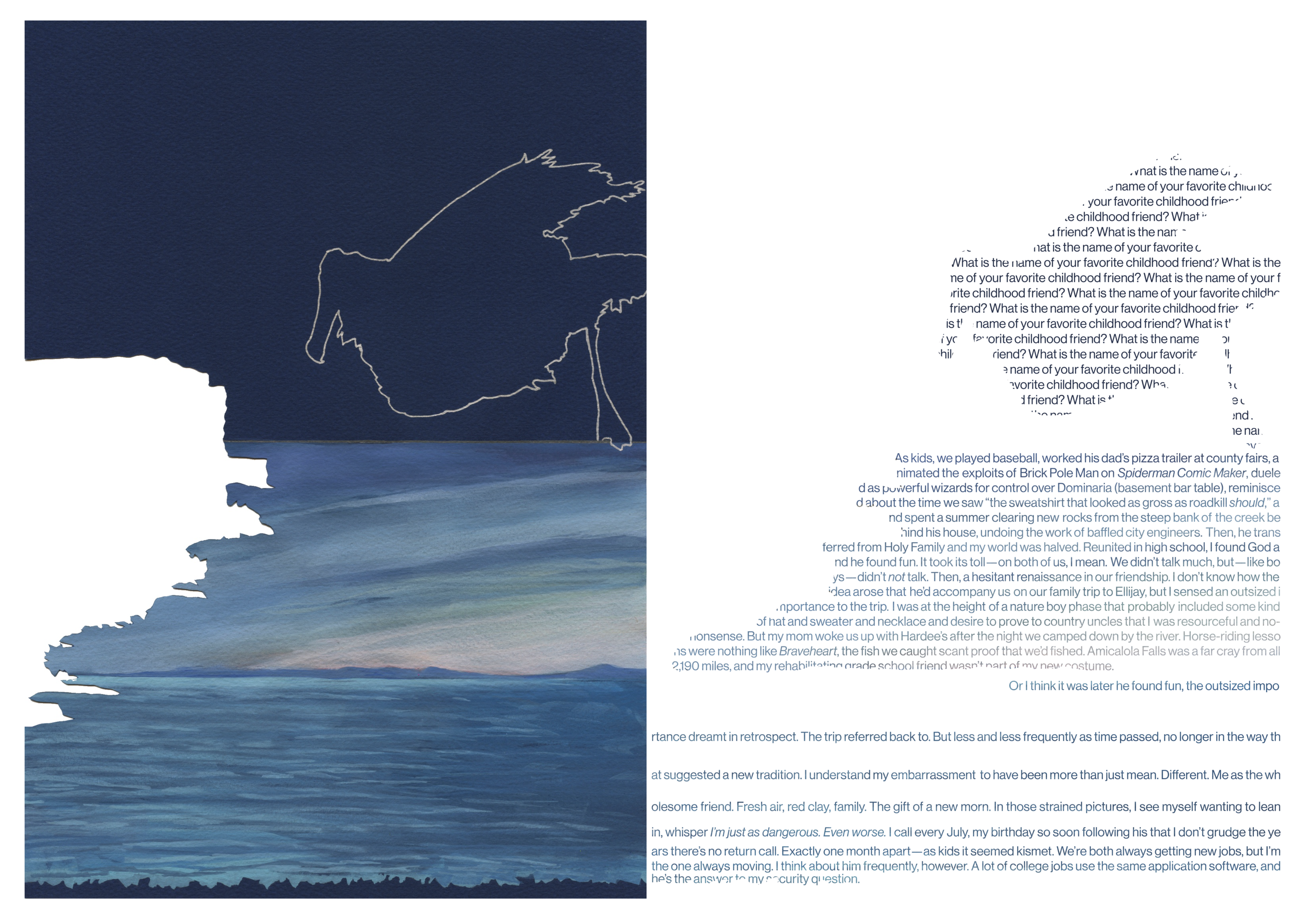
For AS: How do you understand the making of landscape artifact in these images? Do elements of decay/the wear of time play into the negative space that appears in some of these works (like “Esja” and “Fall”)?
AS: I was thinking artifact as something left behind in the landscape by human activity, and souvenirs as an item (or feeling or concept, even) taken away from human experience with and in a place. So, in these drawings and others, I was continually moving between the interrelationship between humans and the land we (often exploitatively) visit and inhabit, and what we leave behind or take away. I likewise thought of the cutouts as both absences and presences such as landforms are to bodies of water—each needs the other to define it, and of course that relationship is ever changing. Modularly assembling the drawings on the wall in different gallery locations and installation incarnations reinforced this allusion to maps and topography—a traveling, mutable map / visual journal, of sorts.
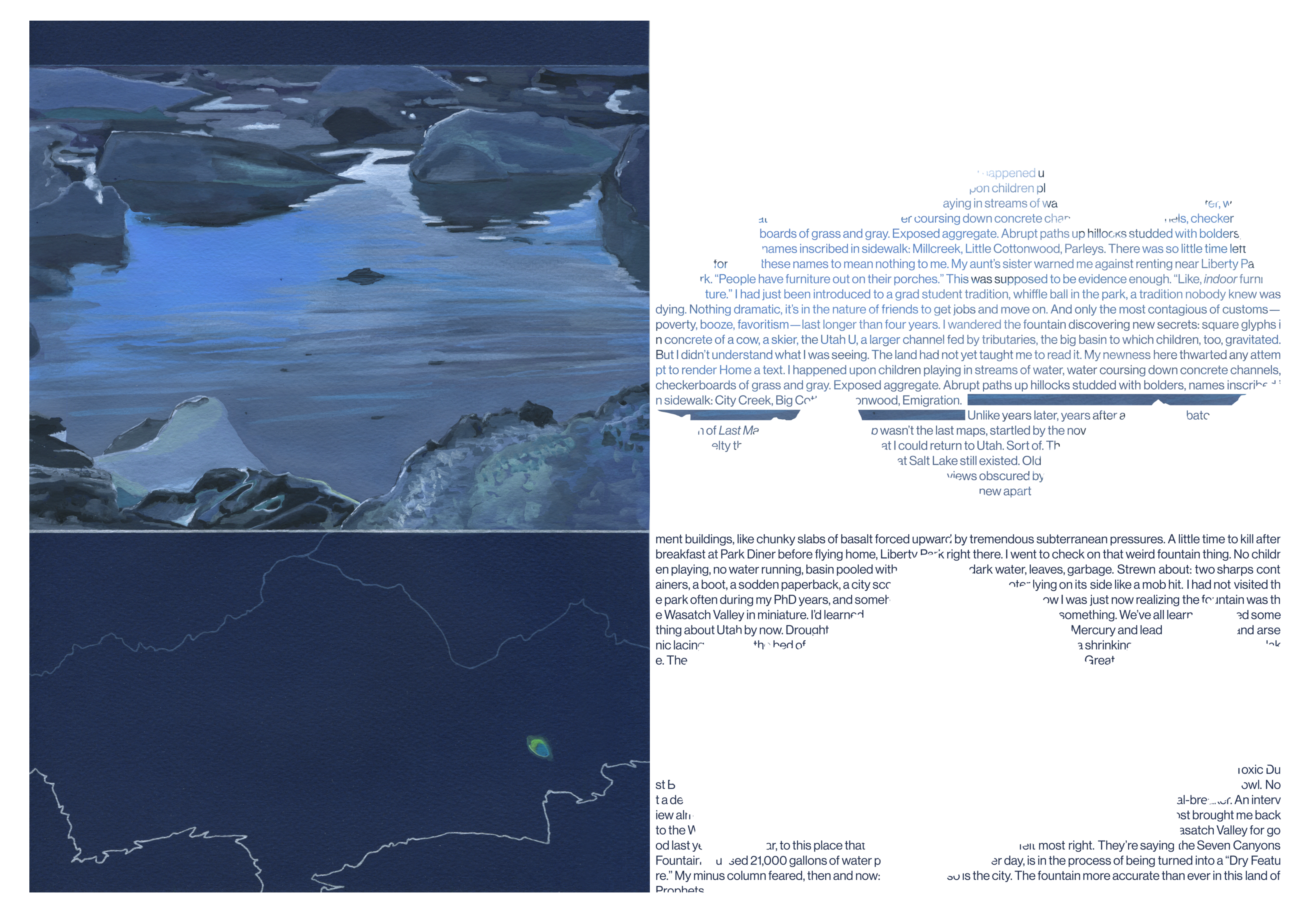
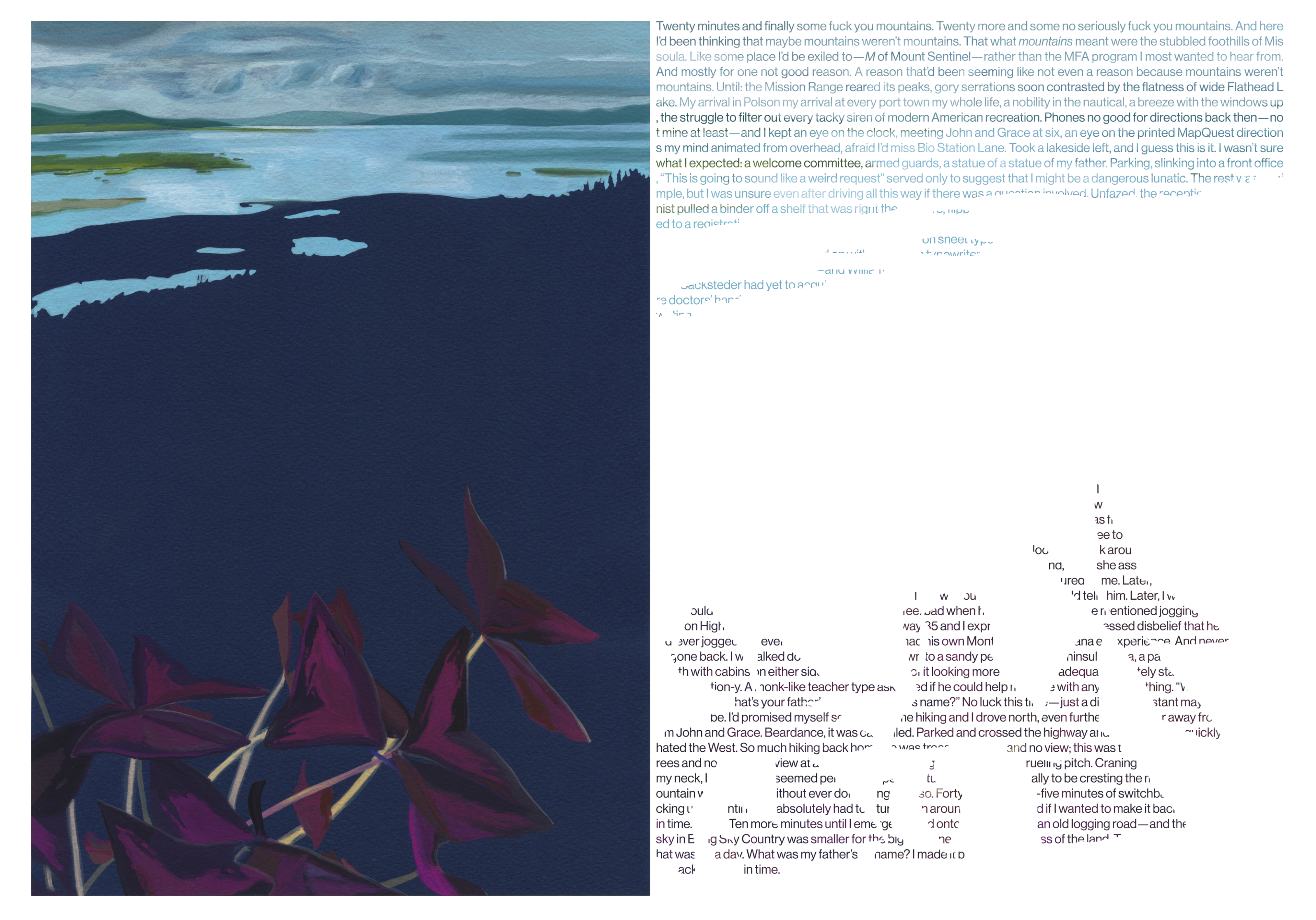
For JS: What is your relationship to legibility? What are you willing (or unwilling) for your readers to not have access to within these visual poems?
JS: Illegibility is really important to this sequence, a way for me to represent the distortions of nostalgia in a memoiristic project. In terms of the Utah pieces, I understand that I have a tendency to romanticize my PhD years and to participate in historically fraught mythologizing of the American West. I will continue to do so, no doubt, but I was fairly stressed out in Utah on a day-to-day level, and the Salt Lake City that I love is on the verge of environmental catastrophe. The visuals of “The Seven Canyons Fountain” echo the textual subject matter: drought and the disappearance of the Great Salt Lake.
In terms of the Georgia pieces, the mountain cabin of my mother’s childhood was a story told to me from our earliest family trips, and it was some time before cracks started to form in that story. A bootstrap narrative subsumed by Fox News-tainted delusions of “limited government” did not jibe with the fact that it was G.I. Bill land and is now worth a lot of money. The illegibility is a way to represent the lacunae in family history, the deliberate and incidental omissions. There are also celebratory pieces: “Setback” simulates conversation during our family’s favorite card game, “Science Fiction,” some sets of bookshelves crammed with sci-fi paperbacks in the Ellijay cabin, “Islands,” my nephews’ introductions to the glories of northern Georgia.
Sometimes I would find during the composition process that a crucial moment or favorite phrasing was getting obscured. “The Biological Station” recounts a trip I took on a whim while visiting friends in Missoula to Flathead Lake, a place where my father had spent a summer in 1971 and then many years waxing nostalgic about to his children. I went to the receptionist and started to explain my unusual pilgrimage to her. She asked what year my father had been there, then pulled down a binder, and there was the sign-in sheet with his signature from decades earlier. That moment is scattered among the small lakes of “Borrow,” well-nigh illegible. Sometimes I would fudge things to leave favorite moments more intact, but I usually accepted a measure of indeterminacy to the process. There was a microscopic chance—when my father signed that sheet at age twenty-one—that his son would look at that signature years later and notice he didn’t yet have doctor’s handwriting. So the illegibility can be seen as also representing a sort of contingency of life, or ephemerality.
The past is further past every day, and two people important to this collection have passed into the ultimate illegibility since I made these pieces last year. My childhood best friend, Roy, who went on a trip with my family to Georgia that’s recounted in “Security Question,” and my beloved Aunt Leah. I’d like to dedicate my pieces to them. Dianne Davenport as well.
I enjoy doing performances of Last Map, which includes projected images that zoom in and out of cropped vectors of text. I’m inspired by Marjorie Perloff’s notion of “differential forms”—the same work of art existing in various mediums. In performance, the text is completely legible/audible, though the words are ephemeral on a temporal level, there-then-gone, unable to be paused or reread. I’m also a pianist and composer, so a project for future years is to add music to these performances.
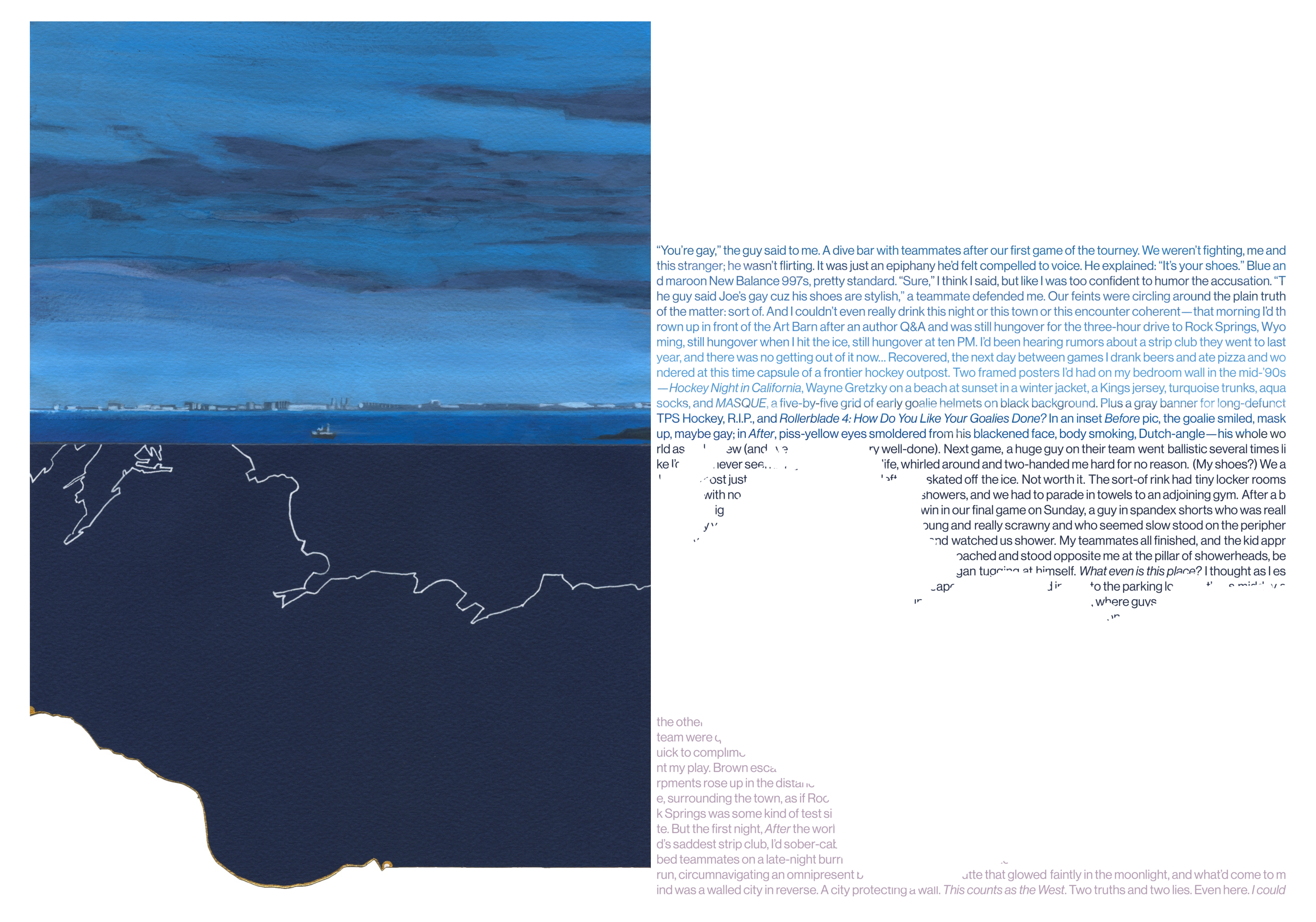
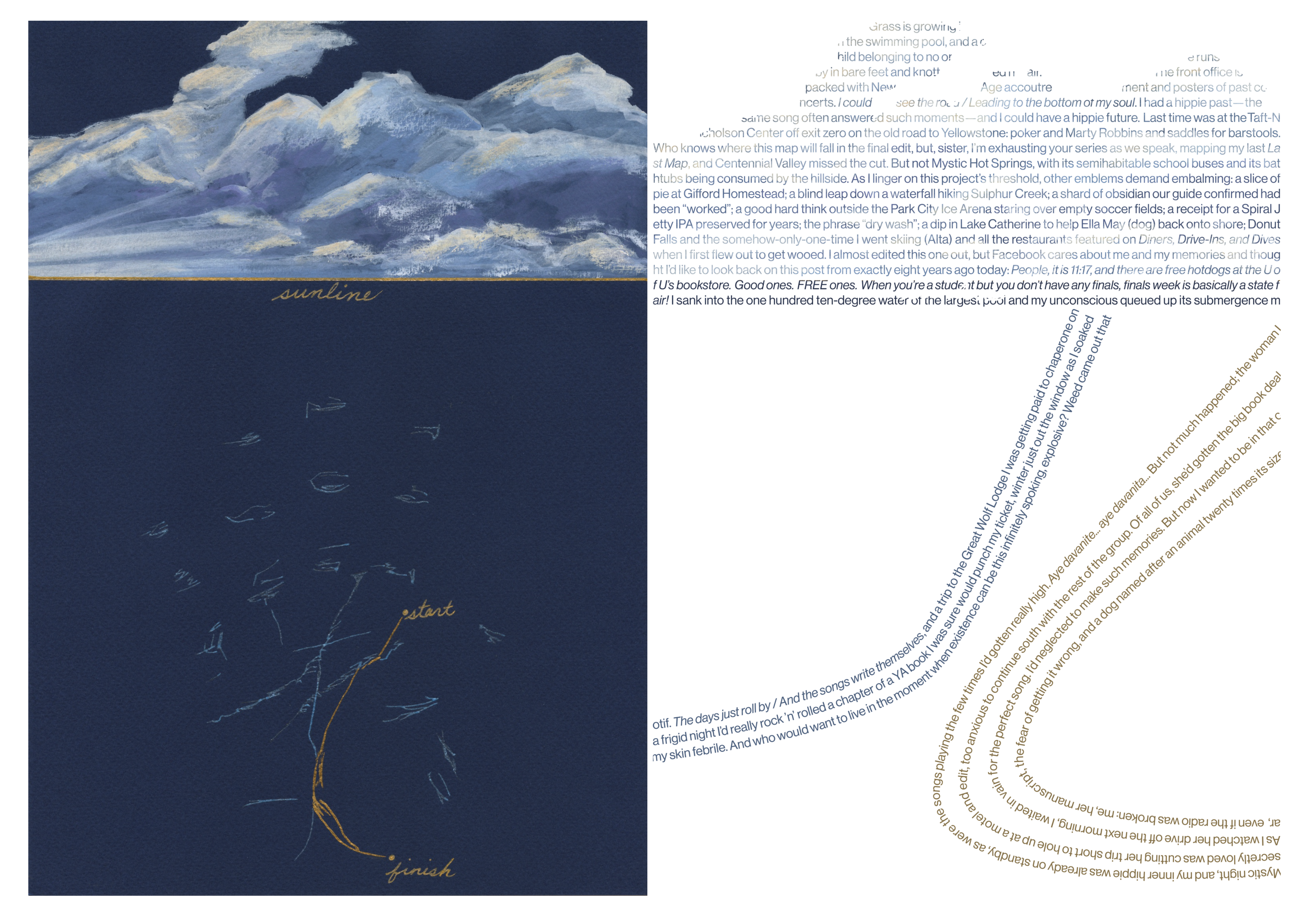
For AS: Your pieces draw attention to the structure of their natural subjects and the movement within and around them. How do you go about composing pieces like this? How do the shapes and forms of these locations come together?
AS: Fittingly, I was composing these drawings, and much of my work, in a mapped-out fashion: using vellum to trace source imagery; trying out the scraps of vellum tracings on the page in relationships to one another—finding the composition and content intuitively; then transferring the tracings with graphite to then work into with ink and gouache. It was a fairly exacting, meticulous approach that gave me a sense of both play and control that I think suited me at the time and was also conducive to traveling and setting up makeshift studios in new places.
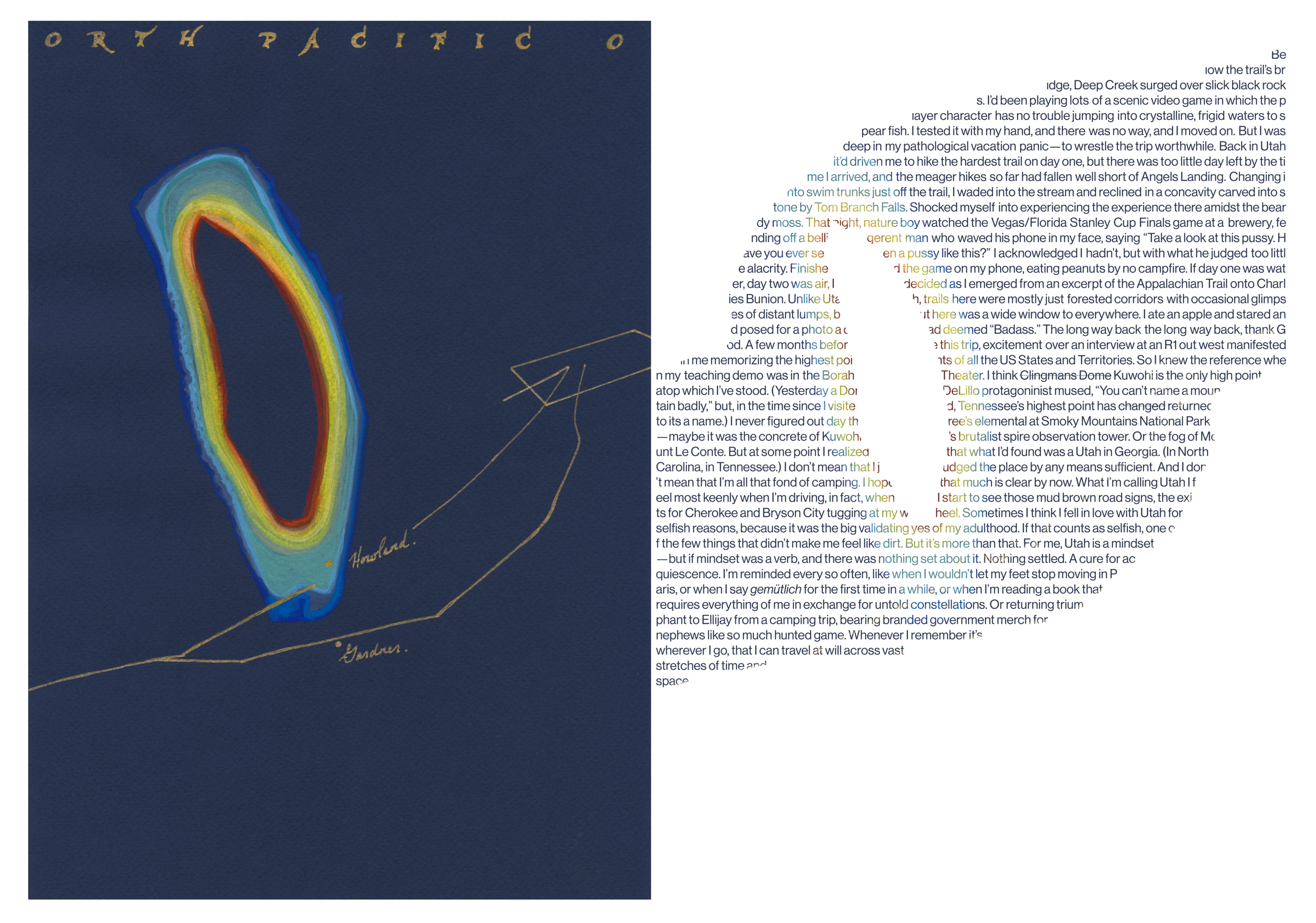
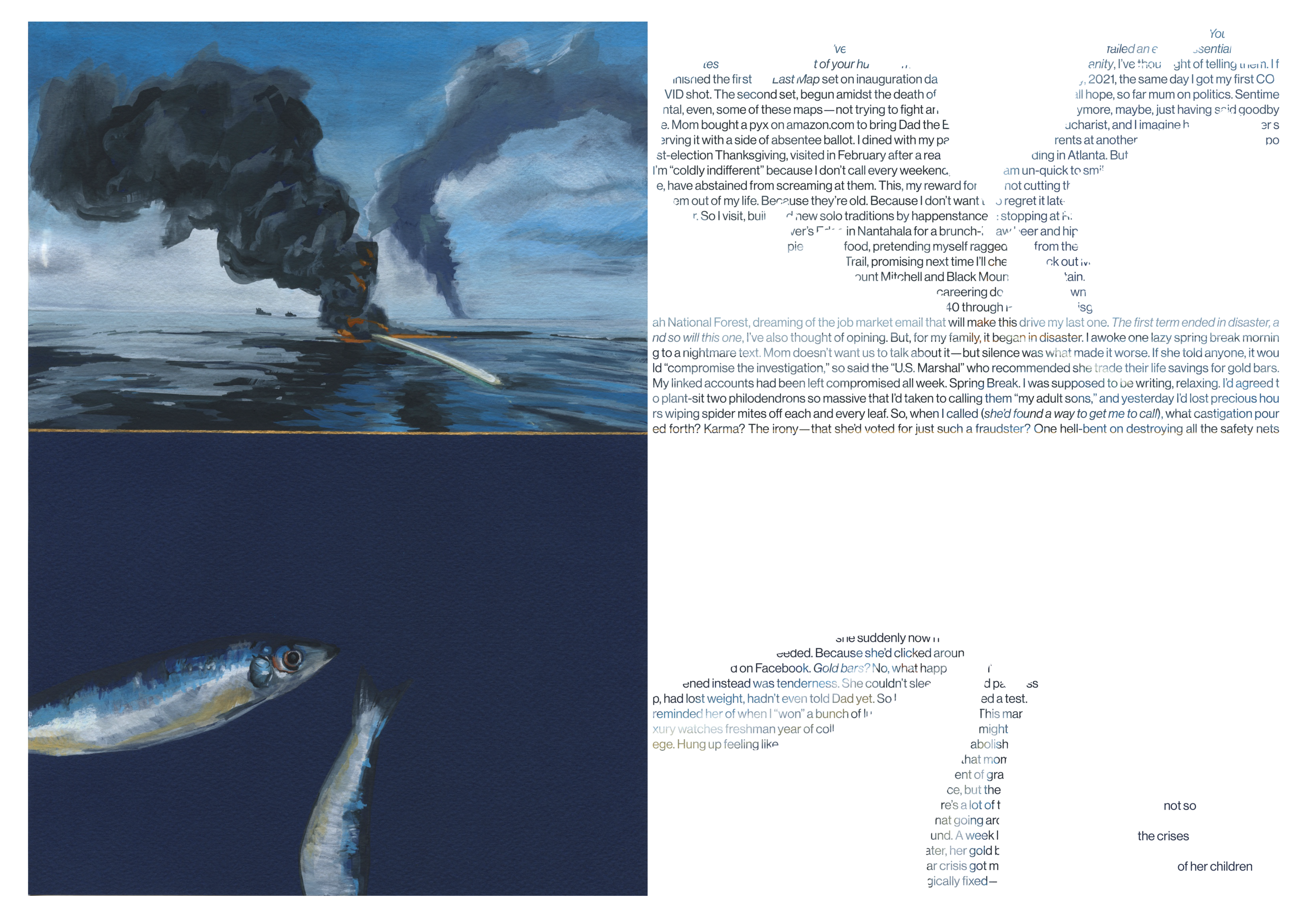
For JS: We were really fascinated by our experiences as readers. We loved having to hold onto the words in each piece as our eyes trapezed across the organic, fluid shapes of the poem––often disrupted by gaps in the body of the text. How does your relationship to the text change or evolve through these specific visual forms? How does your understanding of the geographic place change as you combine your text with these maps? An example we’re particularly curious about is the colorful gap in “Utah, Georgia.” Can you talk a little bit about how this absence works for the text?
JS: In a way, slowly traversing my sister’s art and the texts I’d written felt both like traversing a physical distance, for example Gooseberry Trail in Canyonlands, and like really meditating on memories in a way that neither looking at photos nor even writing a memoir can provide. A deliberate pursuit of slowness, really sitting down and luxuriating in the memories.
A first spread of sixteen Last Map pieces appeared in The Offing in 2021, and admittedly I leapt at what seemed to be Amy’s drawings that would lead to the most interesting treatments for my purposes. When I returned to the remainder of her fourteen drawings, some of them put me at a loss as to how to proceed—and I left “Perfect Circle” to the very end because I had no idea what to do with it. I’m not talking about it as a work of art, but merely in terms of the positive/negative spaces I needed for textual boundary lines. Such difficulties in this sequence forced me to invent solutions that I never would have thought up had things been made easier for me. “Howland” and “Gardner” are two of the islands at the center of speculations about Amelia Earhart’s disappearance, and what I did was flip that hypothetical flight path upside down and reverse it to create a top boundary. I think it looks a little like a hurricane.
Amy says the colorful outline is an elevation map surrounding Howland Island; on a craft level, I was always trying to make whatever decision would give me the most color coming through the text, so the decision was a practical one in that regard. Sometimes I expected a big effect from colors, and the result ended up being more subdued—that was a place, on the other hand, where they really took on a luminous glow. I guess that lacuna (Latin for “pool”) is the last thing I should call the blue “hole” of the island, but that’s still what it looks like to me, and I liked how it created a textual void that in turn can be seen as a blind spot in memory or ideology.
* * *
Amy Sacksteder’s work explores personal and collective relationships to landscape, material, and artifact. She works among painting, collage, drawing, glass, and ceramics. Her work has been shown nationally and internationally, recently at River House Arts (Toledo, OH); David Lusk Gallery (Nashville, TN); I Like Your Work (online w catalog); Saint Kate (Milwaukee, WI); Ox-Bow House (Douglas, MI); and Good Naked x The Middle Room (Los Angeles, CA) among other venues. Her work has been featured in The Offing, the Chicago Tribune, New American Paintings,and included in the Flat File 2022 Program at Ortega y Gasset Projects, where she was also a 2022 and 2024 Artist to Watch. She presently has work included in the Flat File Index at Real Tinsel in Milwaukee. Her work is included in collections at institutions such as Cranbrook Art Museum and Henry Ford Health System in Detroit. Sacksteder is a member of the Long Island City Studio Collective, lives and works outside of Detroit, and is a professor in the School of Art & Design at Eastern Michigan University.
Joe Sacksteder is the author of Make/Shift (Sarabande Books), Driftless Quintet (Schaffner Press), and Hack House (Astrophil Press). His work has been featured in The Atlantic’s culture roundup, and recent publications include LIT, Conjunctions, DIAGRAM, and Michigan Quarterly Review. His album of Werner Herzog audio collages, Fugitive Traces, is streamable for free at Punctum Books. He has a PhD from the University of Utah and currently lives and teaches in Virginia.